The EU Deforestation Regulation includes coffee in its scope. The European Commission's implementation page, current on 21 August 2026, says the rules start to apply to large and medium operators on 30 December 2026 and to most micro and small operators on 30 June 2027. Waiting for the declaration stage is too late for a global buyer: plot, lot, supplier and evidence data need to connect from the RFQ onward.
This is a procurement roadmap, not legal advice. A company's exact role depends on its position in the chain, enterprise size, product code and whether it first places the product on the EU market or exports it. A non-EU supplier may not itself be the regulated operator, but its EU customer will need information and evidence from the origin to complete the file.
Determine product scope and commercial role before ordering. Coffee as a generic description is not enough. Record the product form, relevant Combined Nomenclature or HS code, quantity, country of production, the party first placing it on the EU market and the party responsible for the declaration. Green coffee, processed products and multi-origin blends can create different data paths; confirm the Annex scope and legal role for the actual transaction.
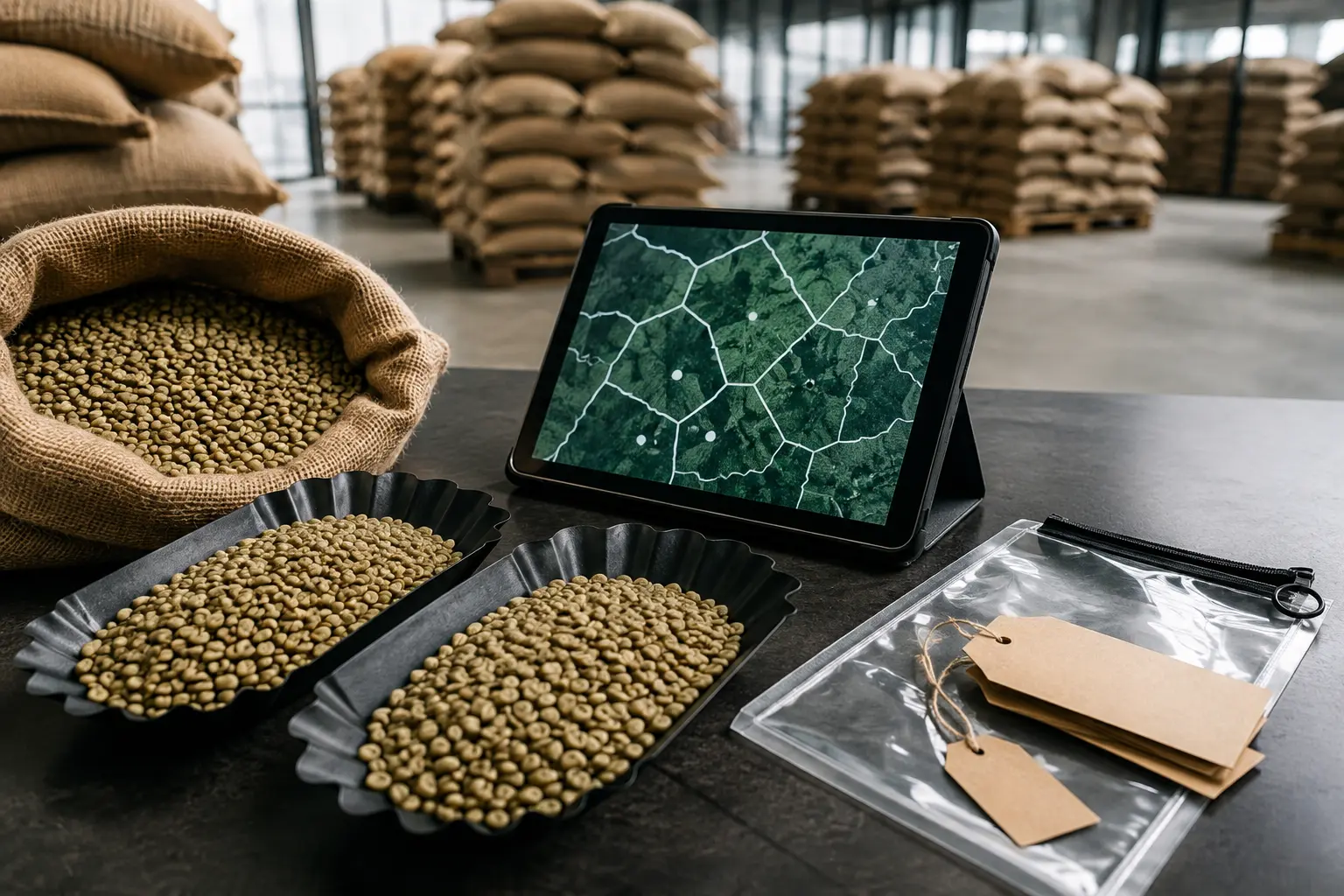
Connect each commercial lot to every production plot. The Commission's current Article 9 information list requires the geolocation of all plots where the relevant commodity was produced, together with the date or time range of production. If a lot combines several farms, all of them must remain retrievable against that lot. Coordinates without a persistent identifier, supplier, season and batch relationship are a detached map, not operational traceability.
Validate data when it is collected. Do not merely receive coordinates; check format, completeness, plot geometry, duplicates, impossible locations and consistency with delivered volume. Record file version, data owner and last change. Where intermediaries consolidate coffee, every lot transformation must preserve the path from the outgoing product to the original plots. Correcting location data after a container reaches port is far more expensive than controlling it in the supply contract.
Connect the two core claims to verifiable evidence. Relevant products must be deforestation-free and produced in line with applicable laws in the country of production. The Commission's current guidance uses 31 December 2020 as the deforestation cut-off. For each origin, define what supports land-use rights, legal production and other relevant legality, and what source makes land-cover status reviewable. A broad supplier declaration that is not tied to plot, lot and production period is not a complete file on its own.
Country risk does not remove information collection. Under simplified due diligence for low-risk countries, information still needs to be gathered even where risk assessment and mitigation can be omitted under the stated conditions. Do not remove geolocation, supplier identity, country, production range or legality evidence from the contract. Maintain a route for new information or substantiated concerns; simplification is not permission to ignore a warning signal.
Turn risk assessment into a buying decision. For chains not using the simplified route, examine data sources, chain complexity, mixing exposure, document reliability, non-compliance history and contradictions among volume, farm and season. Where risk is more than negligible, mitigation may require additional information, independent verification, lot segregation, a different consolidation path or stopping the purchase. Record the decision and owner rather than a completed checkbox.
Control mixing and lot changes in the warehouse. Traceability held only in procurement files disappears if operations do not preserve it. Record inbound lot, silo or location, transfers, combinations, processing and outbound identity. For blends, define quantity allocation and the link between each output and its origin plots before production. The quantity covered by data and declarations should stay aligned with traceable physical quantity.
Put declarations and record retention into the shipment calendar. The Commission explains that a relevant product must be covered by a due diligence statement or, where applicable, a simplified declaration before it is placed on the market or exported. Define who submits, when data freezes, how the reference is checked and how it links to customs documents. Due-diligence records must be retained for five years, making access, backup, change control and file ownership part of procurement design.
EUDR readiness is not a map file added at the end of buying; it is an architecture of data and responsibility from plot to lot and declaration. A coffee buyer who builds that connection into RFQs, contracts, receiving and warehouse controls now has time before 30 December 2026 to find real errors and distinguish traceable offers from incomplete claims.
Use the guide to improve the brief—not to replace order verification.
Final quantity, sales unit, stock, price and timing remain order-specific.